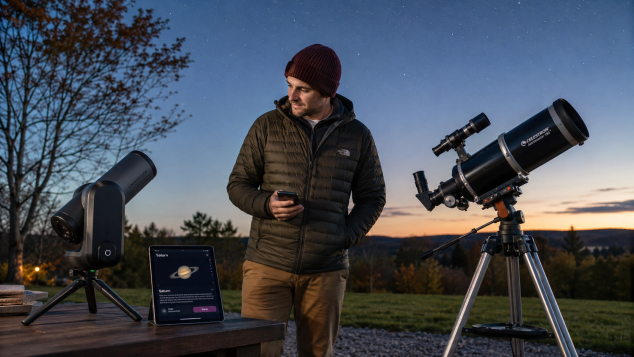
Smart telescopes make it easier to find and photograph objects quickly, while traditional telescopes offer the hands-on experience of learning the sky and observing directly through an eyepiece.
Buying a first telescope used to mean choosing between different sizes and optical designs. Now there is a completely different decision sitting beside them: do you want to look through a telescope, or do you want the telescope to help create an image for you? Smart telescopes have become credible consumer products, and the category is still moving quickly. ZWO, for example, launched its Seestar S50 Pro in August 2026 with a 50mm aperture, dual 4K imaging system, automated targeting, equatorial tracking support, and a claimed battery life of up to nine hours. That makes the smart telescope vs traditional telescope for beginners question much more interesting than it was a few years ago. My recommendation depends on what you picture yourself doing outside. If you want to find nebulae quickly, capture images, and let technology handle much of the frustrating setup, a smart telescope makes a convincing first purchase. If the idea of seeing Saturn's rings with your own eye is the part that gives you goosebumps, I would lean toward a good traditional telescope, especially a tabletop or full-size Dobsonian. September is a great time to think about that distinction because Saturn is already becoming an increasingly convenient evening target ahead of its October 4, 2026 opposition, when it will be visible for much of the night.
A smart telescope for beginners takes many jobs that once required separate astronomy equipment and handles them inside one connected device. You generally place the telescope on a stable support, power it up, connect with a phone or tablet, and select an object from an astronomy database or map in the companion app. Motors aim the telescope at the target and continue tracking it as Earth rotates. Instead of leaning over an eyepiece, you watch a digital image develop on the screen. The especially clever part is live image stacking. The telescope takes a succession of relatively short exposures and combines useful information from them, gradually improving the visible detail while reducing some of the noise that would clutter a single exposure. A faint nebula that looks disappointingly subtle through a modest conventional telescope can therefore appear far more colourful and structured in a stacked smart-telescope image. The original Seestar S50, for example, uses a 50mm apochromatic optical system with a 250mm focal length, built-in imaging filters, onboard storage, Wi-Fi and USB connectivity, all inside an automated alt-azimuth mount. This is why I understand the appeal immediately. A beginner can spend the first clear night exploring objects rather than wondering why the telescope seems determined to point everywhere except at the galaxy shown in the app.
That convenience also explains the biggest smart telescope advantages and disadvantages. I would choose one if my main goal were deep-sky imaging from a backyard, especially if light pollution made visual observing frustrating. Getting a recognizable image of the Orion Nebula, Andromeda Galaxy, or a bright star cluster early in the hobby can be hugely motivating. Images are also easy to save and show other people, which gives smart telescopes a social advantage that I think gets underestimated. The tradeoff is that the experience feels much closer to connected astrophotography. You are looking at a processed digital view rather than photons travelling through an eyepiece directly to your eye. There is also a technology dependency. Batteries eventually need charging, apps can change, wireless connections occasionally misbehave, and a forgotten phone can leave you with a very expensive object sitting in the grass. I would also temper expectations about planets. A compact smart scope designed around wide-field imaging can record the Moon and planets, but a small aperture and relatively short focal length are very different from the characteristics I would choose specifically for detailed visual views of Saturn. Someone searching for a telescope for viewing Saturn because they desperately want that classic first glimpse of the rings may find a conventional telescope much more emotionally satisfying.
A traditional telescope for beginners asks more of its owner, and that is part of its charm. With a basic refractor, tabletop Dobsonian, or larger Dobsonian reflector, you typically point the instrument yourself, use a finder to get close to the target, bring the image into focus, and change eyepieces depending on the view you want. Aperture means the diameter of the telescope's main light-gathering lens or mirror. More useful aperture generally gathers more light and can reveal finer detail, assuming the optics and atmosphere cooperate. An eyepiece determines the magnification you actually use, with shorter focal-length eyepieces producing higher magnification in a given telescope. A Dobsonian is simply a Newtonian reflector mounted on a sturdy, easy-to-move base, which is one reason I like the design so much for beginner stargazing. A decent 6-inch or 8-inch Dobsonian can provide direct views of the Moon and planets while having enough aperture to make brighter deep-sky objects rewarding from a suitably dark location. You will have to learn where things are. At first, that can mean fumbling with a star chart in the cold while questioning every financial decision that brought you there. After a few sessions, finding an object yourself becomes surprisingly satisfying. The sky starts to feel like a place you recognize rather than a menu your phone is navigating.
Accessories are where the ownership difference becomes especially obvious. With a smart telescope, I would keep the initial shopping list short. A stable tripod or leveling base matters because tracking and image stacking suffer when the telescope is sitting on something that moves. Some current models include or support dedicated tripod systems, while particular advanced tracking configurations may require additional mounting hardware. ZWO, for example, recommends its TH10 head and compatible quick-release hardware for an improved equatorial-mode setup with the S50 Pro. After that, I would buy a USB power bank if I planned longer sessions, provided the telescope supports external power while operating. Dew protection moves high on my list in damp climates because condensation on the front optical element can end an observing session surprisingly quickly. A fitted case makes sense if the scope will travel. Your compatible phone or tablet is effectively part of the observing system, so an older device with poor battery life can become an unexpected weak point. Filters deserve more restraint. Some smart telescopes already have useful filters built in, including light-pollution or dual-band options designed to isolate specific wavelengths emitted by some nebulae. The standard S50 includes internal UV/IR-cut and dual-band filtering, so buying extra glass blindly would accomplish very little. I would check the specifications of the exact telescope before spending money on additional filters, storage devices, adapters, or connectivity accessories.
Traditional telescope accessories for beginners require a little more thought because they directly change the viewing experience. I would start with one or two decent eyepieces rather than a box full of cheap ones. A low-power eyepiece gives a wider field that makes finding objects easier, while a shorter focal-length eyepiece provides the extra magnification you may want for the Moon or Saturn on a steady night. A Barlow lens multiplies the effective magnification of an eyepiece and can be useful once you understand the magnifications your telescope can realistically handle. I would not treat one as mandatory on day one. A usable finder scope or red-dot finder is far more important because it helps you aim the main telescope. Refractors and some compound telescopes commonly benefit from a star diagonal, which bends the light path into a more comfortable viewing angle. Mount stability deserves even more attention. A sharp optical tube sitting on a wobbly tripod is miserable at high magnification because every touch makes the planet dance around the field. I would also pick up a dim red-light flashlight so I can read a chart without wrecking my dark adaptation, then use a planisphere or astronomy app to learn what is actually above me. Dew protection may be necessary depending on the climate, and a padded storage solution becomes worthwhile once the telescope starts travelling. A lunar filter is optional rather than essential. The Moon can look extremely bright through a larger telescope, so some observers find a filter more comfortable, although safe lunar observing does not require one.
The actual ownership question, then, comes down to what will make you carry the telescope outside repeatedly. A smart telescope removes a lot of friction. It can locate an object within minutes, track it automatically, and begin producing something visually rewarding while you are still figuring out the names of nearby constellations. That is enormously valuable for a beginner who mainly wants astrophotography or who has previously bounced off astronomy because manual object finding felt tedious. Portability can also be excellent because many smart scopes combine the optical tube, camera, mount and computer into one compact package. The traditional route trades that speed for involvement. You learn how magnification relates to focal length, how atmospheric seeing affects a planet at high power, and how your eyes gradually become better at noticing faint detail. You also gain a clearer upgrade path through eyepieces and eventually different optical tubes or mounts. This is why the best telescope for beginners cannot be judged from a specification sheet alone. I would especially avoid the classic cheap department-store telescope advertised with some enormous magnification number on the box. Magnification is easy to market and easy to overdo. Aperture, optical quality and mount stability have much more influence on how useful the telescope feels. A shaky scope capable of a theoretical 600x is likely to produce a blurry image that races out of view every time you touch the focuser.
If a friend asked me are smart telescopes worth it, I would say yes for a particular kind of first-time buyer. I would recommend one to someone who loves connected technology, wants to photograph deep-sky objects, expects to observe from a light-polluted yard, or knows that complicated setup will keep the telescope indoors. The rapid payoff matters. A recognizable galaxy appearing on your phone during your first few nights can create enough curiosity to keep the hobby going. I would recommend a traditional Dobsonian or good beginner refractor to someone whose dream involves direct visual observing and learning the night sky by actually finding things. For Saturn in particular, I would happily accept the extra effort of a traditional telescope because seeing the rings directly through an eyepiece is still one of those experiences that explains why people become astronomy enthusiasts in the first place. My own ideal first-telescope decision would therefore start with a simple question: which result would make me more excited to go outside again tomorrow night? If the answer is a growing image of a nebula appearing on a screen, I would buy smart. If the answer is locating a tiny planet myself and finally bringing its rings into sharp focus, I would buy traditional. That distinction makes a far better first telescope buying guide than chasing the longest feature list.
Pros:
- Smart telescopes make it much easier to find and track celestial objects.
- Live image stacking can reveal more deep-sky detail than beginners may see through an eyepiece.
- Traditional telescopes provide the satisfying experience of observing directly with your own eyes.
- A good Dobsonian or refractor can be especially rewarding for viewing the Moon and planets such as Saturn.
- Traditional scopes help beginners learn constellations, star-hopping, eyepieces, and basic observing skills.
- Smart telescopes are convenient for capturing and sharing images.
- Both types can be beginner-friendly when matched to the right interests.
Cons:
- Smart telescopes depend on batteries, software, and a compatible phone or tablet.
- Their screen-based experience may feel less immersive to someone who wants classic visual astronomy.
- Compact smart telescopes are not always the strongest choice for detailed planetary observing.
- Traditional telescopes have a steeper learning curve when it comes to finding objects and understanding equipment.
- Eyepieces, finders, mounts, and other accessories can add to the cost of a traditional setup.
- Cheap beginner telescopes with shaky mounts and exaggerated magnification claims can be frustrating.
Bottom Line:
I would choose a smart telescope for a beginner who wants quick results, easy deep-sky imaging, and technology-assisted observing. For someone excited by looking directly through an eyepiece, learning the night sky, and seeing Saturn’s rings with their own eyes, I would recommend a quality traditional telescope, especially a beginner-friendly Dobsonian.
Tags:
smart telescope vs traditional telescope, best telescope for beginners, telescope for beginners, beginner astronomy telescope, beginner stargazing, smart telescopes, telescope accessories for beginners, astrophotography for beginners, Dobsonian telescope