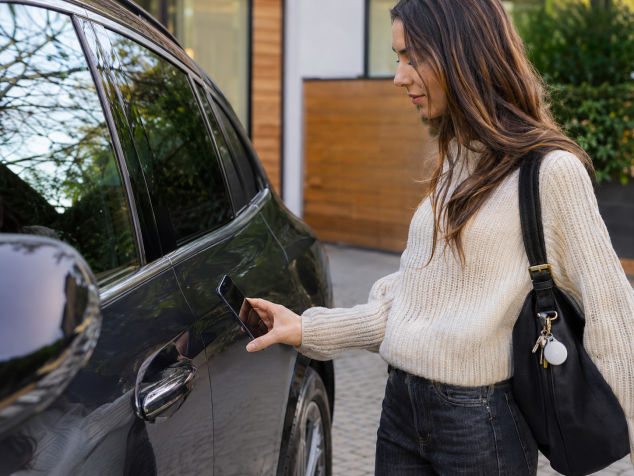
By improving how Bluetooth devices measure distance, this clever technology could change the way trackers, smart locks, and connected devices respond to our presence.
Bluetooth Channel Sounding is one of those technologies I stumbled across and immediately wondered why more people were not talking about it. Bluetooth already connects headphones, trackers, cars, locks, and a ridiculous number of little gadgets around the house, yet determining exactly how far away another Bluetooth device is has traditionally been one of its weaker tricks. Channel Sounding changes that equation by giving compatible Bluetooth Low Energy devices a much more precise way to measure the distance between each other. It was introduced with Bluetooth Core 6.0 as a secure fine-ranging capability, and the Bluetooth SIG has since standardized supporting ranging features around it. For anyone interested in Bluetooth tracker technology or digital keys, that seemingly modest addition could become extremely useful.
So, what is Bluetooth Channel Sounding and how does it work? Older Bluetooth distance tracking often relies heavily on RSSI, or Received Signal Strength Indicator. A device looks at how strong another device's radio signal appears and uses that strength as a rough clue about distance. The problem is obvious once you think about a real house. Walls weaken signals. Furniture gets in the way. Reflections from surrounding objects alter radio propagation. Even the way someone is holding a phone can affect the reading. Channel Sounding measures properties of the radio exchange itself. Its phase-based ranging method sends signals between an initiator and a responding reflector across multiple frequencies, then uses the measured phase changes to help calculate distance. Round-trip timing can provide another distance measurement and contribute to protection against relay attacks. It gives Bluetooth ranging technology considerably more useful information than simply asking, "How loud does this radio signal seem?"
That leads to the obvious question about Bluetooth tracking accuracy. The Bluetooth SIG says Channel Sounding was designed for centimeter-level accuracy, meaning errors measured in tens of centimeters rather than expecting every measurement to land within a couple of centimeters. Early implementations cited by the organization have reached roughly plus or minus 20 centimetres. I would treat that as evidence of the technology's potential rather than a guaranteed number printed on every future tracker box. Antenna design, device orientation, surrounding objects, radio conditions, and the manufacturer's distance-estimation algorithm can all influence real-world performance. Traditional RSSI ranging can become unreliable even at relatively short distances, which explains why an old-style Bluetooth tracker can sometimes tell me that my keys are "nearby" while leaving me to conduct an archaeological excavation of the sofa. Channel Sounding gives precise Bluetooth tracking a much stronger technical foundation.
Bluetooth item trackers are probably the application that makes this easiest to appreciate. Imagine reaching the correct room using a tracker's existing network or proximity features, then having precise device finding become useful for the final part of the search. Knowing that a tag is approximately half a metre away is far more actionable than watching a vague signal-strength indicator move up and down. The Bluetooth SIG specifically identifies Find My-style solutions as a Channel Sounding use case, although actual availability depends on phones and tags containing compatible Channel Sounding hardware and software. The same idea could eventually apply to wallet or card-style trackers where the necessary radio design can fit the product. A keyring holder or adhesive tracker mount would still perform its familiar mechanical job of attaching a compatible tag to keys, remotes, luggage, or another object. Channel Sounding would make the tag inside that accessory more informative when somebody starts looking for it.
Smart locks and other proximity-aware electronics might interest me even more. Bluetooth proximity detection already lets devices make decisions based on whether another device appears to be nearby. Better distance information could let those decisions happen with finer boundaries. A compatible smart lock might be designed to recognize that an authorized phone is genuinely close to the door instead of somewhere farther inside the house. Access-control hardware could use similar ranging information when deciding whether credentials are physically close enough for an action. The Bluetooth Ranging Profile even cites seamless car and door locking as example distance-measurement applications, along with proximity-triggered smart functionality. Other possibilities include smart-home equipment reacting differently as a person approaches or leaves a defined area. Those applications still require manufacturers to implement them, so Channel Sounding should be viewed as an enabling capability rather than a universal feature appearing automatically on existing Bluetooth devices.
Digital key technology is where accurate distance becomes especially important. A phone-based car key works best when the vehicle has a dependable understanding of whether the authenticated phone is actually close enough for an intended action. Similar logic applies to a compatible key fob or door-access device. Channel Sounding includes security mechanisms intended to make distance manipulation more difficult, with phase-based measurements and round-trip timing providing different information that implementations can cross-check. That makes Bluetooth digital keys an obvious area for development. I like the idea because Bluetooth is already deeply involved in wireless access systems, so improved ranging can become part of that ecosystem. It does not mean every Bluetooth car key suddenly gains Channel Sounding. Both ends of a ranging session need appropriate support, and Bluetooth SIG notes that enabling the feature may require updated Bluetooth LE hardware rather than a simple software upgrade to an older product.
The inevitable comparison is Bluetooth Channel Sounding vs UWB. Ultra-Wideband earned its reputation for precise ranging by measuring signal travel time across extremely wide radio channels, and it is already used for secure distance-aware applications. The Car Connectivity Consortium's Digital Key specifications, for example, established UWB alongside Bluetooth Low Energy for location-aware vehicle access. UWB remains an excellent technology for precise ranging, and Channel Sounding does not automatically replace it. What makes Bluetooth Channel Sounding interesting is the possibility of adding much better distance awareness to devices whose designs are already centered around Bluetooth LE. Manufacturers may be able to build products around a Channel Sounding-capable Bluetooth radio without adding a separate UWB ranging system, depending on their requirements. Some designs will continue to favor UWB, while others could combine technologies because each has useful characteristics.
That broader Bluetooth connection is ultimately why I keep coming back to Channel Sounding. Precise ranging sounds like a small technical upgrade until you consider how many frustrating gadget interactions come down to a device having only a fuzzy idea of where you actually are. A tracker that can give genuinely useful distance guidance around the house sounds better to me. A digital key that can make decisions using stronger proximity information feels more dependable. Smart-home devices could eventually make similarly useful distinctions when compatible hardware becomes common. Bluetooth Channel Sounding is already a defined part of the Bluetooth specification, while widespread consumer adoption will depend on manufacturers adding suitable radios and building good ranging algorithms around the measurements. If that happens, Bluetooth could become considerably better at answering one deceptively important question: exactly how close is the other device?
Pros:
More precise distance tracking: Offers the potential for centimeter-level ranging, significantly improving on traditional Bluetooth signal-strength estimates.
Better Bluetooth item trackers: Could make finding lost keys, wallets, and other belongings much easier with more useful distance measurements.
More dependable digital keys: Improved proximity detection could help compatible car keys and smart locks determine when an authorized device is close enough.
Works within the Bluetooth ecosystem: Manufacturers could add precise ranging capabilities to Bluetooth-based products without necessarily requiring separate UWB hardware.
Improved security potential: Built-in ranging security features can help protect compatible access systems against certain distance-manipulation attacks.
Exciting smart-home possibilities: Could enable more accurate proximity-based automation and smarter interactions with connected devices.
Cons:
Requires compatible hardware: Existing Bluetooth devices generally cannot gain Channel Sounding capabilities through a simple software update.
Limited consumer adoption: Support across smartphones, trackers, smart locks, and vehicles is still developing.
Accuracy varies: Walls, interference, device orientation, and hardware design can affect real-world ranging performance.
Doesn't automatically replace UWB: Ultra-Wideband remains highly effective for precise finding and secure digital-key applications.
Potential additional costs: Manufacturers may face higher development and hardware costs when implementing Channel Sounding.
Benefits depend on implementation: Better distance measurements only become useful when manufacturers develop reliable features around them.
Bottom Line:
Bluetooth Channel Sounding is one of the most interesting improvements to Bluetooth technology in years. I love the idea of a tracker that can tell me how close my missing keys actually are, or a digital car key that makes more dependable decisions based on my location. While compatible devices and real-world implementations still have plenty of room to develop, bringing precise distance measurement into the familiar Bluetooth ecosystem feels like a genuinely useful advancement. For me, its biggest appeal is making everyday connected devices a little less frustrating and considerably more aware of their surroundings.
Tags:
Bluetooth Channel Sounding, Bluetooth distance tracking, Bluetooth ranging technology, Bluetooth tracker technology, precise Bluetooth tracking, Bluetooth Channel Sounding vs UWB, Bluetooth vs UWB, Bluetooth digital keys, Bluetooth item trackers,