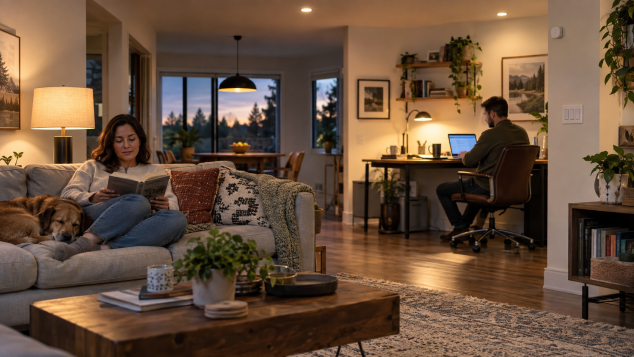
By detecting subtle movement while you sit, read, work, or watch TV, mmWave presence sensors can keep automations running when traditional motion sensors think the room is empty.
There is a particular kind of smart-home failure that gets old very quickly: you are sitting at your desk reading something, barely moving, and the lights suddenly switch off because the room has decided you disappeared. The same thing happens halfway through a movie, while reading on the sofa, or when lying in bed with the lights automated around occupancy. Traditional motion sensors work well when you walk through their field of view. Sitting quietly is where the illusion of a “smart” room starts falling apart. That is what made me pay attention to the mmWave presence sensor. It gives an automation system a much better answer to the question that actually matters: is somebody still here?
An mmWave presence sensor uses millimetre-wave radar to detect what is happening within a defined area. Depending on the hardware, the radar transmits high-frequency radio signals and analyses their reflections to work out information such as movement, distance, or position. Modern radar systems can detect extremely small changes, commonly described as micro-movements, which can include the slight body motion that happens while typing or reading. Some radar implementations are sensitive enough to detect motion associated with breathing. That is why an mmWave radar sensor can continue reporting occupancy when someone appears almost motionless to a conventional motion detector. Radar manufacturers such as Infineon specifically describe 60 GHz presence sensing as capable of detecting micro-motion, while FMCW radar can use reflected signals to determine information about stationary as well as moving targets.
The presence sensor vs motion sensor distinction makes more sense once you compare PIR vs mmWave. A passive infrared sensor watches for changes in infrared energy entering its sensing elements. In practical terms, it is very good at noticing a warm human body moving across different detection zones. Panasonic's explanation of PIR technology describes the sensor as reacting to changes in incoming infrared energy, which is exactly why movement is such an important part of reliable detection. I still like PIR sensors for places such as hallways, closets, stairs, and utility rooms, where somebody usually creates obvious movement and battery operation is convenient. At my desk, PIR has a harder job. My hands might move a few centimetres over a keyboard while the rest of me stays in roughly the same spot. An mmWave motion sensor can hold the room in an occupied state through those quieter periods, allowing the light automation to stop treating stillness as absence.
The feature that really expands what you can do with smart home presence detection is zoning, although the sophistication varies considerably between products. Some sensors simply expose occupied or vacant status. More advanced models let you adjust sensitivity or maximum detection distance, while certain room-mapping sensors can create separate detection areas around a sofa, bed, desk, or dining area. Multi-person tracking is also available on selected hardware rather than being a standard mmWave feature. Aqara's FP2, for example, supports configurable room zones and tracking of multiple occupants, illustrating how far this category can go when the radar hardware and software are designed for spatial tracking. That opens up more interesting automation logic. Presence at the desk can activate task lighting while presence on the sofa keeps the living-room lamps on. A basic smart home occupancy sensor tells you that somebody is somewhere in the room. A more capable one can sometimes tell your automation system which part of the room is occupied.
There is a little more hardware planning involved than the tiny battery PIR sensor you might already have stuck to a wall. Many mmWave models have traditionally required continuous USB power because the radar and processing stay active, so cable routing can become part of the installation. Aqara's FP2, for instance, is a continuously powered Wi-Fi device. Battery-powered designs now exist as well, including models that combine PIR and mmWave sensing, which means constant power is no longer a universal requirement. Connectivity varies just as much. You can find sensors using Wi-Fi or Zigbee, while newer devices may use Thread and expose occupancy through Matter. Zigbee devices may require a compatible hub or coordinator, and Matter-over-Thread products need the appropriate Matter and Thread infrastructure. Once the presence entity reaches your platform, it can control compatible smart bulbs, switches, plugs, relays, or heating and cooling equipment. A mmWave sensor for Home Assistant is especially interesting because Home Assistant can combine presence with other conditions and devices rather than leaving the sensor inside one manufacturer's app. Depending on the sensor, installation may also call for a magnetic bracket, wall or ceiling mount, adhesive hardware, a USB-C cable, power adapter, longer extension cable, or a small stand to get the angle right.
That last part matters more than I initially expected. mmWave sensitivity is one of the technology's strengths, and it also means placement deserves some experimentation. I would avoid aiming a sensor casually through an open doorway toward a hallway or neighbouring room, then assuming software will sort everything out. Moving curtains, fans, plants, glass, reflective surfaces, pets, and robot vacuums can complicate detection depending on the sensor and its filtering. Aqara's own setup guidance recommends keeping radar sensors away from several of these interference sources or marking troublesome areas in software where that capability exists. Radar behaviour around walls and other materials can also vary, so thin partitions and the area immediately beyond the intended room are worth testing rather than guessing about. Infineon's application documentation specifically notes that radar presence systems can react to conditions such as moving curtains and can encounter target-detection issues around walls, with range configuration being one way to control the monitored area. I would expect to spend some time adjusting detection range, sensitivity, exclusion areas, or the physical angle before trusting an mmWave sensor with important automations.
Once it is tuned, the automation possibilities feel far more natural. In a home office, I could have the ceiling light come on when I sit down and remain on while I type quietly for an hour, then switch off a few minutes after the room actually becomes vacant. In the living room, a smart lighting presence sensor could keep movie-night lighting active even when everyone is sitting still. With a zoning-capable room presence sensor, walking from the sofa to a reading chair could activate the lamp beside that chair while allowing lighting around the sofa to shut down later. A bedroom could use occupancy as one condition for climate or lighting behaviour without relying on somebody waving an arm every few minutes. These automations sound less dramatic than voice-controlled blinds or elaborate dashboards, which is part of why I like them. They solve small irritations that happen every day.
There are still reasons to approach mmWave thoughtfully. Some sensors need permanent power, and the easiest mounting position may be nowhere near an outlet. Sensitive radar can create false presence until the room has been configured properly. Advanced zoning and multi-person detection differ by model, while ecosystem support can determine whether all those features actually reach Apple Home, Google Home, Home Assistant, or whichever platform runs the house. Radar also sounds vaguely surveillance-like to some people, although presence radar works from radio reflections rather than capturing photographs or video. Google, for example, describes its own mmWave presence hardware as detecting occupancy through radio-wave reflections without collecting images. For me, the appeal of the mmWave presence sensor is much simpler. Smart-home automation becomes considerably more useful when the house can tell the difference between an empty room and a person quietly sitting in one. That fixes a surprisingly basic weakness in home automation, and it is the kind of upgrade I notice every time the lights stay on without asking me to wave at the ceiling.
Pros:
- Detects people who are sitting still far more reliably than typical PIR motion sensors
- Helps prevent smart lights and devices from switching off while a room is still occupied
- Some models support room zoning and adjustable detection areas
- Multi-person detection is available on certain sensors
- Works well for offices, living rooms, bedrooms, and other spaces where people often remain relatively still
- Can integrate with platforms such as Home Assistant, Matter, Zigbee, Thread, or Wi-Fi depending on the model
- Makes presence-based automations feel more natural and dependable
Cons:
- Many models require continuous power and careful cable placement
- High sensitivity can lead to false detections from fans, curtains, pets, or activity outside the intended area
- Setup and tuning can take more effort than installing a basic PIR sensor
- Advanced features such as zoning and multi-person tracking vary considerably between products
- Compatibility depends on the sensor, protocol, hub, and smart-home platform
- Placement near doorways, thin walls, or neighbouring rooms can cause unwanted detections
- Radar-based sensing may raise privacy questions for some users, even though it does not capture images
Bottom Line:
mmWave presence sensors solve one of the most annoying weaknesses in smart-home automation: devices assuming you have left simply because you stopped moving. They require more thought during setup, but in rooms where people spend long periods sitting still, I think they are one of the most genuinely useful smart-home sensor upgrades available.
Tags:
mmWave presence sensor, smart home presence detection, PIR vs mmWave, presence sensor vs motion sensor, smart home occupancy sensor, mmWave radar sensor, room presence sensor, smart lighting automation, Home Assistant presence sensor,