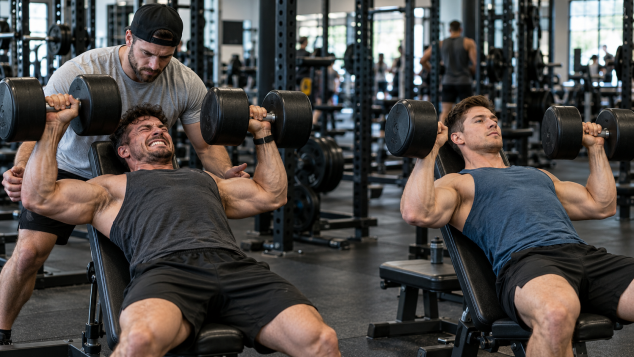
Do you need to train to failure to build muscle? Learn how RIR works, when to push harder, and follow a practical four-day workout split.
There's always a lifter grinding through a bench rep while the spotter practically deadlifts the bar. Across the room, someone finishes a hard set, racks the weights, and looks suspiciously comfortable. Who's building more muscle? In the training to failure vs reps in reserve debate, my money is usually on the second approach. You don't need to train to muscular failure to grow. Stopping around one to three reps short can produce similar muscle hypertrophy, provided the sets are challenging and you train consistently. I enjoy the occasional all-out set, but making every exercise a personal survival test is a lousy way to organise a week.
Momentary muscular failure means you cannot complete another full repetition despite genuinely trying. Technical failure arrives earlier, when the next rep would require swinging, bouncing, or abandoning good form. Reps in reserve (RIR) estimates how many clean repetitions you could still perform. Imagine dumbbell bench presses: 3 RIR means you could manage three more; 2 RIR means two; 1 RIR means one slow, difficult rep remains; 0 RIR means you've reached your limit. To estimate it, notice how your last repetitions slow and ask whether another controlled rep is realistically there. You'll improve with practice. Failure on the first of three sets can leave your later sets much weaker, even after resting.
For hypertrophy, training close to failure gives a muscle a meaningful challenge, but the very last possible rep isn't magic. The ACSM's 2026 resistance-training position stand found that training to momentary fatigue did not consistently improve outcomes, and a July 2026 meta-analysis of 20 studies found no statistically significant muscle-growth advantage for either failure or non-failure training. That analysis did find a small advantage for non-failure training in dynamic strength, which is a separate outcome from muscle size. Exact ideal RIR targets remain uncertain, and stopping too early may compromise the stimulus. Failure removes guesswork about effort. I occasionally take a final set of controlled cable curls or lateral raises to 0–1 RIR. With heavy squats, I'd rather preserve 2 RIR and walk away knowing my technique still belongs to me.
Here's how I would actually programme it. Monday is Upper Body A: barbell bench presses for three sets of 6–10 reps at 1–2 RIR, chest-supported rows for three sets of 8–12 at 1–2 RIR, then seated dumbbell shoulder presses for two sets of 8–12 at 2 RIR. Finish with two sets each of cable triceps pushdowns and dumbbell curls for 10–15 reps at 1–2 RIR. Tuesday is Lower Body A: three sets of squats for 6–10 at 2 RIR, three Romanian deadlift sets for 8–10 at 2 RIR, two leg-curl sets for 10–15 at 1 RIR, and three calf-raise sets for 10–15 at 1–2 RIR. The demanding lifts come first while coordination is fresh. Wednesday is for recovery, perhaps an easy walk.
Thursday's Upper Body B starts with three sets of incline dumbbell presses for 8–12 reps at 1–2 RIR and three sets of lat pulldowns or assisted pull-ups for 8–12 at 1–2 RIR. Add two lateral-raise sets for 12–20 at 1 RIR, then two sets each of cable curls and overhead triceps extensions for 10–15 at 1 RIR; the final isolation set can occasionally reach technical failure. Friday's Lower Body B uses three leg-press sets for 10–15 at 1–2 RIR, two hip-hinge sets such as back extensions for 8–12 at 2 RIR, two sets of split squats for 8–12 per leg at 2 RIR, and two seated leg-curl sets for 10–15 at 1 RIR. Rest two to three minutes after demanding compound sets, roughly one to two minutes after isolation work. Weekends are for rest, walking, or mobility. As recovery permits, I build towards around ten challenging weekly sets per muscle group.
If you're new to lifting, I'd simplify the whole arrangement. A Monday-Wednesday-Friday full-body plan can cover a squat or leg press, a hip hinge, a press, a row or pulldown, and optional curls or calf raises. Start with one or two sets of 8–12 per exercise, keeping 2–3 RIR and at least a day between sessions. Learn what challenging reps feel like without regularly testing absolute failure, especially on squats and hinges. For progressive overload, suppose you bench 20 kg dumbbells for three sets of eight. Build towards three controlled sets of ten at your target RIR, then move up to the next available weight and work back through the range. Log your results; guesses have terrible memories.
My verdict? For building muscle without failure on every set, 1–3 RIR is my default, with occasional failure reserved for stable, low-risk isolation exercises when I feel recovered. Both approaches can work, and experienced lifters may find selective failure useful for judging effort or squeezing value from a final set. But fatigue has a cost: if today's heroic curls wreck the next session, that bargain doesn't look especially clever. Keep the challenging sets coming, add reps or weight when they're earned, and give yourself enough recovery to repeat the process. A workout shouldn't need a dramatic ending to be productive.
Pros:
Effective Muscle Growth: Training with 1–3 reps in reserve (RIR) can produce muscle growth comparable to training to failure.
Better Fatigue Management: Stopping slightly short of failure can preserve energy for subsequent sets and workouts.
Improved Recovery: RIR training may reduce unnecessary fatigue, making consistent training easier.
More Sustainable Progress: Managing intensity helps maintain productive weekly training volume.
Flexible Training Approach: Occasional failure sets can still be useful for isolation exercises like biceps curls and lateral raises.
Beginner-Friendly: RIR encourages controlled technique while helping newer lifters learn to judge their effort.
Cons:
RIR Takes Practice: Estimating how many repetitions remain can be difficult, particularly for beginners.
Risk of Undertraining: Stopping too early may limit muscle growth if sets aren't sufficiently challenging.
Failure Creates More Fatigue: Regularly reaching muscular failure can reduce performance during subsequent sets.
Higher Technical Risk: Training to failure on heavy squats or deadlifts can increase the likelihood of technique breakdown.
Individual Differences: Exercise selection, training experience, and recovery capacity influence which approach works best.
Bottom Line:
Leaving 1–3 reps in reserve is my preferred approach for long-term muscle growth. Research suggests you can build comparable muscle without pushing every set to complete failure, while potentially managing fatigue more effectively. I still think occasional failure training has its place, especially on controlled isolation exercises, but there's little reason to turn every workout into an endurance contest. For me, consistent progress, challenging sets, and reliable recovery beat chasing that one final rep every time.
Tags:
training to failure vs reps in reserve, do you need to train to failure to build muscle, training to failure vs not, RIR training, how many reps in reserve for muscle growth, building muscle without failure, RIR workout split, training to failure