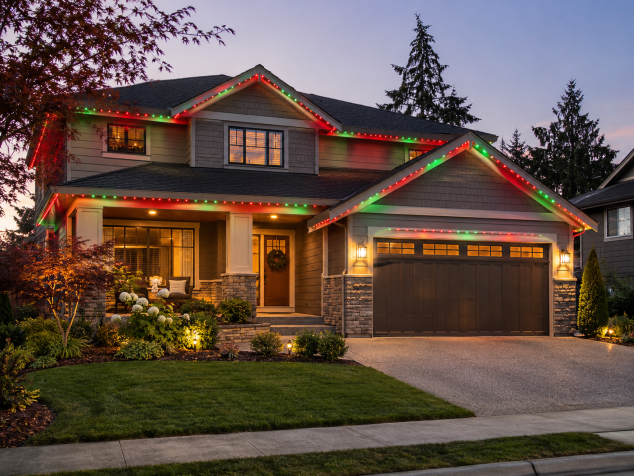
Permanent LED Christmas lights might be one of the smartest home upgrades for anyone who loves decorating. Install them once and enjoy customizable outdoor lighting for every season without dragging out the ladder.
Permanent outdoor Christmas lights are one of those smart home upgrades that make increasingly more sense the longer you think about them. These programmable LED lighting systems are designed to remain installed throughout the year, allowing homeowners to change their exterior lighting for different holidays and occasions through a smartphone app. Considering how much effort goes into hanging Christmas lights every winter, often involving a ladder and some particularly uncooperative Canadian weather, I can understand their growing appeal. What interests me most about permanent LED holiday lights is how useful they can be outside the festive season. A well-designed system can become part of a home's exterior lighting, providing something worth using throughout the year. The convenience alone is appealing, although the technology behind these systems is what really caught my attention.
Permanent outdoor LED lights typically consist of small LED modules or flexible lighting strips mounted beneath soffits, along rooflines or around other exterior architectural features. Professionally installed systems often use discreet, colour-matched aluminum mounting tracks that conceal the wiring and blend into the home's exterior during daylight hours. The electronics are particularly interesting. Standard RGB LEDs combine red, green and blue light to produce a wide range of colours, while RGBW outdoor lighting incorporates a dedicated white-light channel that can produce a more natural-looking white. Individually addressable LED lights contain control circuitry that allows compatible controllers to adjust specific lighting modules independently. This means different sections of a roofline can display entirely different colours and patterns simultaneously. Compared with conventional Christmas light strings, permanent roofline lighting offers considerably more control over how a home's exterior looks.
The accompanying electronics and accessories deserve just as much attention as the lights themselves. A typical permanent outdoor lighting system includes LED modules, mounting channels, a power supply, a smart controller, extension cables and weather-resistant electrical connectors. The power supply converts household electricity into the lower-voltage DC power required by the LEDs, while the controller processes commands from a companion smartphone application and sends lighting instructions along the system. Extension cables help bridge gaps between illuminated sections, such as where a roofline changes elevation. Some smart outdoor lighting systems also support Amazon Alexa, Google Home or the Matter smart home standard, depending on the manufacturer. I would pay particular attention to the quality of the controller and electrical connectors when comparing systems. An impressive set of LEDs becomes considerably less useful if the accompanying electronics are unreliable or the app is frustrating to operate.
Programmable outdoor lighting really comes into its own once you start exploring the customization possibilities. Compatible systems allow homeowners to establish separate lighting zones, adjust individual colours, control brightness and save personalized lighting patterns. Traditional red and green lights work beautifully for Christmas, while orange and purple can give the house a suitably eerie appearance for Halloween. A red-and-white display seems like an obvious choice for Canada Day, and a favourite colour scheme could make someone's birthday feel a little more special. For summer entertaining, I'd favour a softer, warm-white setting around the patio. The feature I find particularly worthwhile is architectural accent lighting, where selected LEDs can illuminate roof peaks or highlight the front entrance while the remaining lights stay off. Scheduling features make it possible to automate these displays and have them switch off at a reasonable hour. Your neighbours will probably appreciate that last feature as much as you do.
Anyone researching permanent Christmas lights in Canada should take weather resistance seriously. Quality systems are engineered for prolonged outdoor exposure, although their ability to withstand harsh winters varies considerably. An IP65 rating indicates protection against dust and water jets, while IP67 indicates dust-tight construction and protection against temporary immersion under specified testing conditions. These ratings do not establish how well electronics perform in extreme cold. Manufacturers specify separate operating temperature ranges, and a system rated down to -20°C may be unsuitable for regions that regularly experience temperatures below that threshold. UV-resistant housings help reduce deterioration caused by prolonged sunlight, while properly sealed connections and secure mounting hardware help protect the installation from moisture and seasonal weather. I would also check the ratings of the power supply and controller individually, since these components may require more protection than the LED modules themselves.
Do permanent Christmas lights use a lot of electricity? Their operating costs can be relatively modest, depending on the installation's length, power consumption, brightness and daily operating schedule. LEDs are generally more energy-efficient than traditional incandescent holiday bulbs, although operating an extensive roofline display every evening will naturally increase overall electricity consumption. Calculating the approximate cost is straightforward: divide the system's actual power consumption in watts by 1,000, multiply by the number of operating hours, and then multiply by your electricity rate per kilowatt-hour. For example, a system drawing 100 watts and operating four hours every evening would consume approximately 12 kWh over 30 days. At an illustrative electricity rate of $0.15 per kWh, that amounts to $1.80 before additional charges and standby consumption. Dimming the lights and scheduling shorter operating periods can help keep energy consumption down. For everyday use, I suspect most homeowners would find a subdued lighting setting perfectly sufficient anyway.
Choosing between professional outdoor LED lighting installation and a DIY permanent outdoor lighting kit largely depends on the property and the homeowner's budget. Professional systems generally cost considerably more upfront, particularly on multi-storey homes with complicated rooflines, although custom-fitted mounting tracks can provide a cleaner appearance. DIY kits can reduce installation expenses, provided the mounting surfaces are compatible and the roofline can be accessed safely. Look for electrical equipment approved for use in Canada, follow local electrical requirements and use GFCI-protected outdoor outlets where applicable. New electrical wiring or outlets are jobs I would leave to a licensed electrical contractor. Before purchasing, I would also investigate whether individual LED modules can be replaced, how readily replacement controllers are available and whether the warranty covers installation labour. Proprietary hardware and cloud-dependent smartphone apps are legitimate long-term concerns. I would want reasonable assurance that a system permanently attached to my house would remain serviceable even if the manufacturer discontinued its current product range.
So, are permanent Christmas lights worth the investment? I think they can be an excellent home improvement for anyone who regularly decorates for holidays or appreciates attractive exterior lighting throughout the year. The upfront expense deserves careful consideration, particularly because occasional maintenance and component replacement may still be necessary. Homeowners who only illuminate their houses for a couple of weeks each December may find conventional Christmas lights more economical. For those who enjoy seasonal decorating and expect to use architectural lighting regularly, however, year-round Christmas lights offer considerably more lasting value. Personally, I would prioritize a discreet RGBW system with replaceable components and dependable scheduling features. I like the idea of giving a house a completely different character whenever an occasion calls for it, especially when the entire transformation can happen from the comfort of the living room. As far as practical smart home technology goes, permanently retiring the Christmas decorating ladder sounds like a pretty worthwhile upgrade to me.
Pros:
- Eliminates the hassle of installing and removing Christmas lights every year.
- Offers customizable colours and lighting patterns for holidays and special occasions.
- Smartphone controls make adjusting brightness and scheduling displays convenient.
- LED technology generally consumes less electricity than traditional incandescent Christmas lights.
- Quality weather-resistant systems can withstand harsh Canadian winters.
- Discreet mounting tracks can blend into a home's exterior.
- Provides attractive architectural accent lighting throughout the year.
- Reduces the need to climb ladders for seasonal decorating.
Cons:
- High upfront purchase and professional installation costs.
- DIY installation can be challenging on complicated rooflines.
- Weather resistance and long-term durability vary between manufacturers.
- Replacement components may be expensive or proprietary.
- Smartphone app functionality may depend on continued manufacturer support.
- Occasional maintenance and LED replacements may be necessary.
- Frequent year-round use can increase overall electricity consumption.
Bottom Line:
I think permanent LED Christmas lights are a worthwhile investment for homeowners who enjoy seasonal decorating and appreciate practical smart home technology. The initial expense is probably the biggest drawback, so choosing a reliable, weather-resistant system with replaceable components is important. Having the freedom to change the entire appearance of your home's exterior from your phone is a genuinely useful feature. I'd be particularly interested in an RGBW system that doubles as subtle architectural lighting throughout the year. Being able to leave the ladder in the garage every December is a pretty convincing selling point, too.
Tags:
permanent outdoor Christmas lights, permanent LED holiday lights, permanent outdoor LED lights, year-round Christmas lights, programmable outdoor lighting, smart Christmas lights, permanent roofline lighting, RGBW outdoor lighting