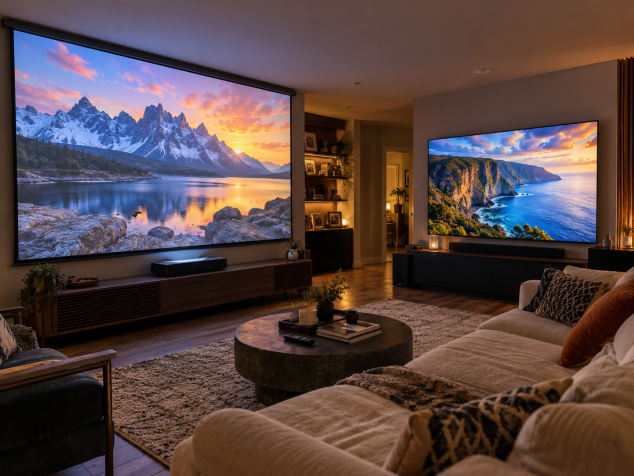
A 100-inch TV delivers bright, straightforward everyday viewing, while a laser TV can create an even larger, cinema-style image from just inches away. Here’s what each setup is really like to own, install, game on, and live with.
I used to think the choice between a projector and a television was pretty straightforward until 100-inch TVs started feeling like something a normal person could realistically consider. At that size, the laser TV vs giant TV question gets much more interesting. A giant TV is exactly what it sounds like: a conventional flat-panel display stretched into home-theatre territory. A laser TV is usually a 4K ultra-short-throw projector, often called a UST projector, designed to sit very close to a wall or projection screen and create an image around 100 to 120 inches, sometimes larger. I also think laser TVs deserve to be separated from the portable projectors people carry between rooms or take outside. A serious laser TV projector is brighter, physically larger and meant for a fairly permanent home-theatre installation. It generally expects a proper screen, a suitable media console and a room arranged around it. Once I started picturing either setup in my own living room, the decision became much more about how I would actually live with the screen than about chasing the biggest diagonal measurement.
A physical 100-inch television is genuinely enormous. A 16:9 screen with a 100-inch diagonal is roughly 87 inches wide before you account for the bezel, so simply getting one through a hallway, around a stair landing or into an elevator can become part of the buying decision. Then you have to find enough uninterrupted wall space for it and decide whether a media stand that wide makes sense. Wall mounting cleans up the room, although the mount, wall structure and installation hardware all need to support a display of that size safely. Professional installation starts looking very sensible once two people carrying the television feels optimistic. A UST setup handles that physical problem differently because the projector itself is compact compared with the image it produces. The projector sits on a low cabinet only inches from the screen in many installations, although the exact throw distance changes with the model and image size. It cannot simply be shoved flush against the wall. Moving it forward or backward even a small amount can noticeably change the picture geometry. I love the idea of getting a 100 inch projector screen or 120-inch picture without owning a 100-inch slab of glass and electronics, although the projector, cabinet and screen still claim real space in the room.
Ambient light is where the fantasy of an effortless laser projector TV replacement runs into living-room reality. A giant television produces its own light directly toward the viewer, so daytime viewing, lamps and open curtains are much easier for it to deal with. A projector sends light toward a screen and relies on that light being reflected back at you. Bright room light can wash out blacks and reduce perceived contrast, even when the projector itself is quite bright. This is why an ALR screen for UST projector use matters so much. A good UST-compatible ambient-light-rejecting screen is engineered for the steep projection angle coming from below while rejecting a meaningful amount of unwanted room light. I would treat that screen as close to essential if the projector were going into my everyday living room. Projecting directly onto a plain painted wall can work for experimentation, although wall texture, unevenness and paint colour can affect sharpness, brightness uniformity and contrast. Spending serious money on a UST projector and then using a mediocre wall would feel like buying excellent speakers and placing them inside a cupboard.
Picture quality makes the ultra short throw projector vs TV discussion more personal. A good giant TV has some immediate advantages because black levels can look deeper, highlights can appear more intense and HDR usually has greater visual punch in a room with uncontrolled lighting. Fine details and interface text also have that crisp, direct-display quality I notice immediately when I sit fairly close. A strong UST projector has a different appeal. When the lights are low and a movie fills a 110- or 120-inch screen, the image can feel much closer to a small cinema than an oversized television. That scale changes the experience more than I expected. Faces become genuinely huge, wide shots have room to breathe and even familiar films can feel different. Colour from modern laser light sources can also be excellent. I would still give a premium TV the easier path to convincing blacks and bright HDR in most living rooms. For evening movie watching, though, I completely understand why someone would choose the larger projected image. The 100 inch TV vs projector decision starts to feel less like a specification contest and more like deciding whether you value direct-display punch or cinematic scale.
Gaming pushes me toward the giant-TV side more quickly. Large-screen gaming on a UST projector can be fantastic because a racing game, sports title or open-world game at 100-plus inches has a ridiculous sense of scale. The catch is that UST gaming capabilities vary quite a bit between models. Input lag, supported refresh rate, 4K gaming modes and HDMI features need to be checked individually. Some current projector designs offer strong low-latency modes and HDMI 2.1 features, while others are still designed primarily around films and streaming. I would never assume that an expensive 4K ultra short throw projector automatically behaves like a premium gaming television. Giant TVs are generally easier to shop for if a PlayStation, Xbox or gaming PC is central to the room because specifications such as 4K at high refresh rates, variable refresh rate support and dedicated game modes are usually easier to identify. Proper certified HDMI cables become important when you are trying to use higher-bandwidth gaming features. For someone who spends most evenings switching between streaming and console gaming, the predictability of a large TV would carry a lot of weight for me.
Installation has hidden costs on both sides. With the giant TV, I would budget for a properly rated wall mount, suitable anchors or mounting hardware and probably professional help. Cable-management channels or an in-wall solution make a huge difference because dangling HDMI and power cables look especially messy under a screen the size of a dining table. A UST setup avoids hanging an enormous display, although alignment takes patience. The projector has to sit at the correct height and distance, and the screen needs to be installed accurately. Physical positioning should come first because relying heavily on digital geometry correction can cost usable resolution and image quality. A low media console or dedicated UST projector cabinet can also become necessary because a normal deep console may push the projector too far into the room. On either setup, I would expect to add a soundbar or AV receiver with speakers since a screen this large deserves audio that feels appropriately scaled. A streaming box can improve the experience if the built-in software ages poorly. I would also plan for a good surge protector, along with the game console and cable-management hardware already living around the system. Those accessories can turn an apparently simple UST projector vs TV price comparison into a much closer race.
Long-term ownership is another reason I would think beyond the showroom demo. Laser light sources are designed for many hours of use, which removes the old ritual of replacing traditional projector lamps, although longevity ratings vary by model. A UST projector still contains cooling hardware, so fan noise and heat are things I would listen for before buying. The screen also becomes part of the equipment. A large ALR screen needs to stay clean, flat and protected from accidental knocks. TVs eliminate the projector alignment issue, yet a 100-inch panel is hardly casual furniture. Moving house with one would make me nervous, and servicing or replacing something that large could be awkward. Panel technology creates its own considerations too, including image-retention concerns on some OLED displays and blooming or black-level compromises on some LCD-based sets. Software ages on both platforms, which is why I like the idea of treating a separate streaming box as replaceable infrastructure instead of expecting the television or projector interface to remain useful forever.
If I were building a dedicated movie room, I would be very tempted by the laser TV. Getting a 110- or 120-inch picture from hardware sitting near the wall has a wonderful home-theatre appeal, especially when the room can be darkened and there is space for a proper UST ALR screen. In my main living room, I would probably buy the giant TV. I watch during the day, I game regularly and I like being able to turn on a display without thinking about room light or whether something has nudged the projector slightly out of position. Someone chasing the biggest cinematic image possible may land on the UST side for completely sensible reasons. Someone who wants consistent brightness, strong gaming support and simpler everyday viewing may feel happier living with the giant panel. That is what makes the laser TV vs TV choice interesting to me now. Both can give you a screen that would have sounded absurdly large a few years ago. The real question is which kind of enormous screen fits the way your room actually gets used.
Pros:
- Laser TVs can create a 100- to 120-inch image without bringing a massive physical panel into the house.
- A good UST projector can deliver a very cinematic feel, especially in a darker room.
- Giant TVs handle daylight and ambient light more easily and usually deliver stronger perceived contrast and HDR impact.
- Large TVs are generally simpler for everyday viewing because there is no projector alignment to worry about.
- Giant TVs often have stronger gaming support, including lower input lag, high refresh rates, VRR, and HDMI 2.1 on compatible models.
- UST projectors sit only a short distance from the screen, making them much easier to place than traditional long-throw projectors.
- Both options can become the centrepiece of a serious home-theatre setup.
Cons:
- A 100-inch TV is physically enormous, making delivery, mounting, moving, and future relocation difficult.
- Laser TVs usually perform best with a UST-compatible ALR screen, which adds significant cost.
- Projected images can lose contrast and black-level performance in bright rooms.
- UST projectors require careful positioning, and even small placement changes can affect image geometry.
- A proper laser TV setup may also require a low media console or dedicated UST cabinet.
- Projector gaming performance varies widely, so input lag, refresh rate, and HDMI features need to be checked model by model.
- Giant TVs may require professional mounting, reinforced hardware, and substantial wall space.
- Both setups can become expensive once sound systems, mounts or screens, cables, streaming hardware, and installation are included.
Bottom Line:
For my main living room, I would choose the giant TV because it suits daytime viewing, gaming, and casual everyday use with less fuss. A laser TV would tempt me more for a dedicated movie room, where a 110- or 120-inch projected image and a proper ALR screen could create a much more cinema-like experience.
Tags:
laser TV vs giant TV, laser TV vs TV, ultra short throw projector vs TV, UST projector, UST projector vs TV, 100 inch TV vs projector, 100 inch TV alternative, laser projector TV replacement, 4K ultra short throw projector, 100 inch projector screen,