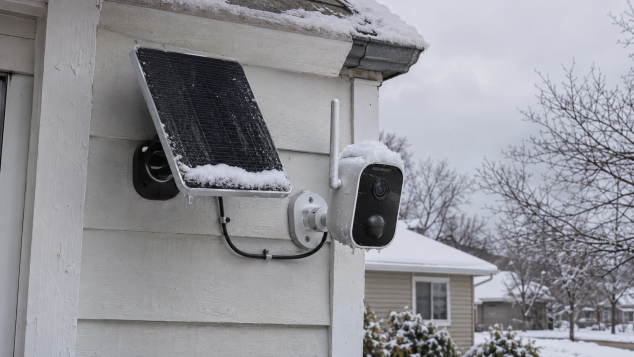
Compare cold-weather charging, snowy panels, useful accessories, and best fit for your home.
Nothing makes an outdoor security camera feel less convenient than a low-battery notification in the middle of a freezing January morning. Suddenly, that clever wireless camera mounted above the garage means finding a ladder, putting on gloves, and wondering why I thought installing it so high was a good idea. This is exactly why the solar vs battery security camera debate becomes more interesting in winter. My preference generally leans toward solar-powered cameras because automatic charging can eliminate much of the routine maintenance. However, that advantage depends heavily on sunlight exposure and how the camera handles freezing temperatures. A standalone battery camera with generous battery capacity might actually demand less attention in a heavily shaded location. The deciding factor is how much work each setup creates once shorter days and snowstorms enter the picture. I'd rather spend a few extra minutes planning the installation than discover halfway through February that my supposedly low-maintenance security system has developed a rather demanding personality.
One detail worth understanding before buying anything is that most solar-powered outdoor security cameras are rechargeable battery cameras with a solar panel attached. The internal battery runs the camera, and the panel replenishes that battery whenever enough sunlight is available and charging conditions are suitable. The battery keeps the camera working overnight and through periods without useful sunlight, provided it has enough stored energy. Some specialized solar systems include additional energy storage or cold-weather power management, although the underlying principle remains similar. A standalone rechargeable outdoor security camera relies on stored battery power without that automatic solar top-up. Once its battery runs low, you generally need to remove the battery, connect a charging cable, or take the camera indoors, depending on its design. Certain models use replaceable batteries instead. I find this distinction important because the word "solar" can make a product sound completely independent of battery maintenance. In reality, you're still managing a battery, just with a potentially helpful source of energy attached.
The biggest challenge for a solar security camera in winter is the combination of limited sunlight and cold-weather charging restrictions. Shorter daylight hours reduce the time available to collect energy, and prolonged cloud cover can leave a small panel producing very little electricity. Snow accumulation makes matters worse by blocking sunlight from reaching the cells. Interestingly, cold weather itself doesn't automatically stop a solar panel from generating power. The battery can be the limiting factor. Many lithium-ion batteries can supply power below freezing while their charging systems restrict recharging at low temperatures to prevent damage. Some cameras operate at temperatures around -20°C yet stop accepting a charge below 0°C. Other systems use battery technology or charging controls designed for lower temperatures. This is why checking the manufacturer's separate operating and charging temperature specifications matters. A solar panel might be generating electricity on a bright winter afternoon while the camera refuses to accept that charge. So, do solar security cameras work in winter? Absolutely, under suitable conditions. Whether they can maintain their battery level throughout a cold spell is a different question.
Standalone battery cameras face their own winter frustrations. Cold temperatures can reduce available battery performance, and a camera that seemed perfectly happy during autumn might report a surprisingly low charge during a freezing spell. Lithium-ion battery chemistry becomes less efficient at low temperatures, sometimes causing temporarily reduced available capacity. Then there's the camera's actual workload. A front entrance camera recording every delivery and passing vehicle will consume more energy than one watching a quiet side gate. Frequent live viewing adds another demand, especially if I'm checking the driveway every time I hear a suspicious noise that turns out to be the neighbour's recycling bin. Nighttime illumination and unreliable wireless connections can also affect power consumption. I would prioritize sensible motion detection zones and recording settings that reduce unnecessary activity without sacrificing important security coverage. These adjustments benefit both technologies. A solar camera with excessive power consumption can drain faster than its panel replenishes it, while an efficiently configured battery camera may last surprisingly well between charges.
Installation is where I think the maintenance comparison really gets decided. Consider a camera mounted beneath the eaves beside a front entrance. The location might be ideal for monitoring visitors, yet the roof overhang could prevent a solar panel from receiving meaningful winter sunlight. A camera above the garage presents another problem: excellent visibility, followed by an inconvenient climb whenever snow needs clearing or the battery requires attention. For solar installations, I prefer the flexibility of positioning the camera where it provides the best security coverage and placing the panel somewhere with better sunlight. In the Northern Hemisphere, a reasonably unobstructed south-facing position is often a sensible starting point. An adjustable mounting bracket helps optimize the panel's angle for the lower winter sun and may encourage snow to slide away. I'd also check the complete installation's weather resistance. IP65 and IP66 ratings describe protection against dust and water jets, with IP66 tested against more powerful jets. They don't establish whether the camera can charge or operate reliably in freezing temperatures.
A few well-chosen outdoor security camera accessories can make solar installations considerably easier to maintain. An external solar panel is particularly useful when the camera's built-in panel sits in a shaded location, provided the camera supports an external connection. I'd compare the panel's rated wattage with the manufacturer's requirements because insufficient output can struggle to keep up with daily consumption. Compatibility matters just as much as wattage. A panel with the wrong connector or unsupported electrical specifications is hardly an upgrade. Weather-rated solar panel extension cables can help move the panel into a sunnier location, although excessive cable length may introduce voltage losses, and manufacturer limits should be respected. Secure adjustable brackets and corrosion-resistant mounting hardware are worth the expense, especially where snow loads and winter winds are concerns. I would also consider a manufacturer-approved protective housing for particularly exposed equipment, as long as it doesn't obstruct the lens or interfere with motion detection. Any cover should preserve required ventilation and access to the charging connections. A little care during installation can prevent an impressive amount of winter annoyance.
Battery-powered cameras have accessories worth considering, too, particularly for anyone dealing with long periods of freezing weather. A spare rechargeable battery pack is probably my favourite convenience accessory, assuming the camera uses removable, model-compatible batteries. Swapping a depleted pack for one charged indoors is much easier than leaving a security camera offline while its battery charges. Manufacturer-approved USB charging cables or compatible charging docks also make the process more predictable. For cameras with permanently installed batteries, I'd pay close attention to mounting accessibility before purchasing, since the entire device may need to come indoors. Repeatedly exposing charging connectors to melting snow or moisture is another avoidable headache, so any seals should be properly restored afterward. Local storage deserves consideration as well. Some cameras support microSD cards, while others use compatible storage hubs that can remain indoors. Local recording may reduce dependence on cloud storage, although card endurance, storage capacity, and supported operating temperatures still matter. Storage accessories won't solve cold-weather battery limitations, but they can make the overall system more practical.
After comparing the maintenance demands, I'd generally choose a solar-powered security camera for a location with reliable winter sunlight, accessible panel placement, and a charging system suited to local temperatures. Under those conditions, automatic battery replenishment can dramatically reduce the number of times I need to physically handle the camera. A standalone battery-powered security camera gets my vote for heavily shaded locations or particularly snowy environments where keeping a panel clear would become another recurring chore. A large-capacity battery and efficient recording settings can make that arrangement quite manageable. There's also the longer-term ownership question. Rechargeable batteries gradually lose capacity, mounting hardware weathers, and replacement accessories may become harder to find over several winters. I'd consider the cost and availability of replacement battery packs before committing to either system. Where a suitable electrical supply is available, a properly installed wired camera is also worth investigating for minimizing charging-related maintenance. For wireless security cameras, though, my winter verdict is straightforward: solar usually requires less attention when the panel receives dependable sunlight and the charging system can use it. In consistently shaded or severely cold locations, a thoughtfully chosen standalone battery camera may be the more practical option. Convenience should still mean convenience after the first snowfall.
Pros:
- Less manual charging with solar: Solar-powered cameras can automatically replenish their batteries when sufficient sunlight is available.
- Convenient for hard-to-reach locations: A well-positioned solar panel can reduce the need to remove cameras mounted above garages or near rooflines.
- Flexible solar panel placement: External panels and extension cables can help capture better winter sunlight.
- Reliable alternative in shaded areas: Standalone battery cameras can be more practical where trees or buildings block sunlight.
- Simple battery maintenance: Cameras with removable rechargeable batteries allow quick swaps using a spare battery pack.
- Adjustable power consumption: Motion detection zones and recording settings can help extend battery life for either camera type.
- Flexible installation: Both options can operate without a dedicated electrical connection, making them useful for outdoor locations.
Cons:
Limited winter solar charging: Shorter days and prolonged cloud cover can prevent solar panels from generating enough energy.
Snow and ice accumulation: Solar panels may require occasional clearing to maintain charging performance.
Cold-weather battery limitations: Freezing temperatures can reduce battery performance and restrict recharging, depending on manufacturer specifications.
Manual charging inconvenience: Standalone battery cameras may need to be removed or accessed during freezing weather.
Installation challenges: Solar cameras require careful panel positioning, while both types should remain accessible for maintenance.
Additional accessory costs: External panels, mounting brackets, extension cables, and spare batteries can increase the overall investment.
Gradual battery degradation: Rechargeable batteries lose capacity over time, potentially increasing maintenance after several winters.
Bottom Line:
I'd choose a solar-powered security camera for most outdoor locations that receive dependable winter sunlight. Automatic charging can significantly reduce maintenance, particularly when the camera is mounted somewhere inconvenient to reach. However, solar power loses much of its advantage when panels spend weeks shaded or covered in snow.
Tags:
solar vs battery security camera, solar security camera winter, battery powered security camera, outdoor security camera, winter security camera maintenance, solar powered outdoor security camera, outdoor security camera cold weather