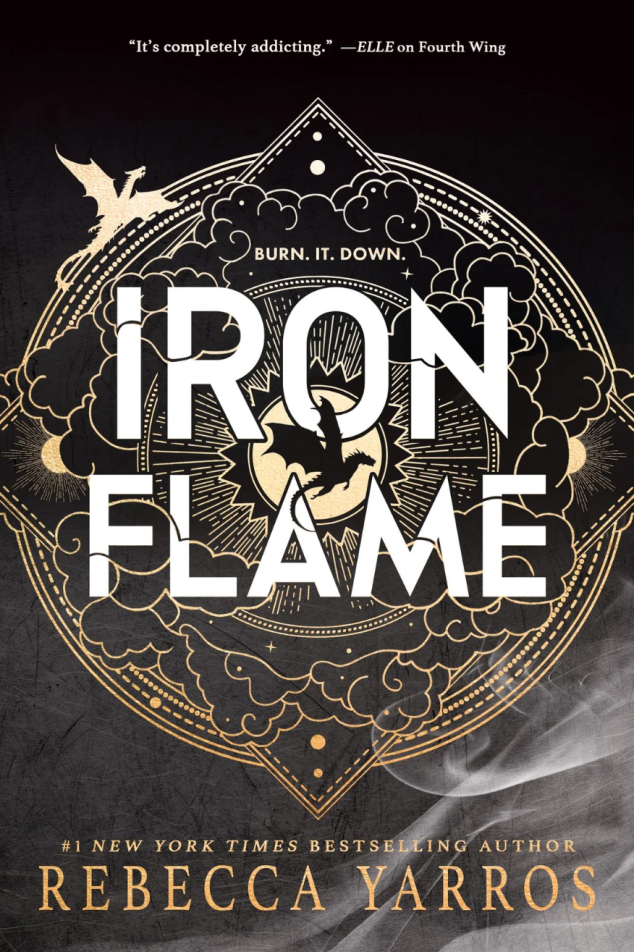
The title Iron Flame captures Violet Sorrengail being forged by pressure as her strength, responsibilities, and emotional scars deepen.
The Iron Flame meaning becomes much clearer once Violet Sorrengail’s second year is viewed as a process of being forged under pressure. “Iron” can represent endurance, discipline, and the hardening that comes from surviving repeated strain. “Flame” carries the heat of dragon fire along with danger, destruction, and transformation. Put together, the title describes something shaped by extreme heat that still has the capacity to burn. There is also a literal explanation inside Rebecca Yarros’s novel: the phrase “iron flame” appears in the ancient instructions connected to activating the wardstone with the fire of seven dragon breeds. That makes the Iron Flame title meaning unusually satisfying because the words belong to the book’s mythology while also fitting what happens to Violet. The character symbolism is my reading rather than confirmed authorial intent, but by the final chapters it is difficult to look at those two words without seeing Violet reflected in them.
The “iron” part especially suits the change between Fourth Wing and Iron Flame. Violet entered Basgiath knowing everyone considered her body a liability, so much of the first book revolved around finding ways to survive a system designed for physically stronger riders. Her second year asks something harsher from her. She returns carrying knowledge about venin, Aretia, Brennan, Xaden, and a rebellion that could get people killed if she says the wrong thing to the wrong person. She is still dealing with injuries and punishing training, yet the pressure has spread far beyond her body. Her judgment is tested. Her loyalties become dangerous. Even the knowledge she once depended on as her greatest advantage becomes complicated when official history turns out to be deliberately incomplete. That is where the idea of iron starts to feel more interesting than a simple metaphor for strength. Violet is being heated, struck, and forced into a new shape by information she can no longer unknow.
Varrish’s treatment of Violet is probably where that interpretation clicked most strongly for me. His torture is designed to discover exactly how much physical and emotional pressure she can absorb before giving up the secrets she is protecting. He repeatedly hurts her and has her mended so the process can continue, while Violet refuses to give him what he wants. Calling that resilience barely captures what the experience does to her. Violet survives, although survival leaves damage behind. Her hallucinated conversations with Liam show how desperately she needs something familiar to hold onto while Varrish tries to dismantle her sense of control. The Iron Flame symbolism works here because iron is forged through punishment from heat and force. Violet’s ability to endure never makes that punishment harmless. Every time she proves harder to break, the story raises the uncomfortable question of what repeated hardening might eventually cost her.
“Flame” works on a different level. Dragons make fire an obvious part of the imagery, and Violet’s existence has become inseparable from Tairn and Andarna. Yet fire in Iron Flame is especially important because it can protect something or destroy it depending on where it is directed. The wardstone plot makes that idea literal. Violet spends much of the novel trying to understand how the wards were originally created, eventually discovering that the missing piece involves seven dragon breeds rather than the six everyone believes exist. Andarna’s true significance suddenly changes the equation. When the wards at Basgiath fall, that knowledge becomes essential to restoring them, with the process demanding an enormous sacrifice from Violet’s mother. So when readers ask why is it called Iron Flame, one answer is sitting directly inside the mechanics of the story: dragon fire, ancient knowledge, and the wardstone converge around a phrase that Violet has spent the novel trying to understand.
What makes the title linger, though, is the tension between iron and flame. Iron suggests something solid enough to hold its shape. Flame is restless and constantly changing. Violet spends much of the book caught between those impulses. She wants certainty from Xaden after discovering how much he concealed from her, and she keeps pushing for complete honesty because secrets have become associated with betrayal. Then she learns that reality is messier than the clean answers she wants. Xaden has another dangerous secret in his second signet. Her government has built national security around suppressed information. Even Violet’s attempt to protect her friends by keeping them uninformed ends up creating its own kind of distance. Her Violet Sorrengail character development becomes a struggle to grow tougher while keeping enough flexibility to reconsider what she believes. Iron without heat stays unchanged. Heat without something strong enough to withstand it destroys whatever it touches.
That is also why the title feels heavier after the ending. Violet reaches the battle at Basgiath carrying responsibilities she could barely have imagined when she first crossed the parapet. She helps uncover the truth about the wards, recognizes Andarna’s importance, and fights for people whom Navarre’s leadership has spent years keeping in the dark. The cost arrives almost immediately. Lilith Sorrengail dies powering the wardstone, and Xaden channels magic from the earth while trying to save Violet, turning himself venin in the process. Those events make the Iron Flame book meaning feel much darker than a heroic image of somebody becoming powerful. Violet’s expanding abilities cannot insulate her from grief or consequences. Greater strength simply gives her the capacity to carry burdens that have grown heavier. By the end, the heat surrounding her has intensified so much that the real question is how much of herself she can preserve inside it.
That is why the meaning of Iron Flame by Rebecca Yarros feels richer after finishing the novel than it does when first seeing the title on the cover. The phrase has a concrete place in the story’s wardstone lore, yet it also describes the shape of Violet’s second year remarkably well. Iron evokes the endurance she develops under relentless pressure. Flame evokes dragons, destructive power, and the transformations that keep remaking her world. Together, they capture a heroine being forged by experiences that demand increasing toughness while constantly threatening to consume something personal in the process. Violet comes out of Iron Flame harder to break, carrying deeper scars and far more dangerous knowledge. The title fits because she has spent the entire novel inside the forge.
Pros:
- The title works on multiple levels: “Iron” suggests endurance and hardening, while “flame” connects naturally to dragons, danger, and transformation.
- It fits Violet’s development: Her second year forces her to withstand physical pain, emotional strain, secrecy, and heavier responsibility.
- The symbolism grows stronger as the story progresses: The title means more after the wardstone discoveries, Andarna’s role, and the events at Basgiath.
- It reflects the cost of becoming stronger: Violet’s growth comes with grief, injury, difficult choices, and increasing emotional pressure.
- It has a literal connection to the plot: The phrase “iron flame” is tied to the wardstone and the fire of the seven dragon breeds.
Cons:
- The symbolism is partly interpretive: Rebecca Yarros has not clearly confirmed every metaphorical meaning readers may attach to “iron” and “flame.”
- The title can seem vague at first: Its significance is easy to miss until much later in the novel.
- Some readings can become overly broad: Nearly every difficult moment in Violet’s story could be forced into the “forged by fire” metaphor if the analysis goes too far.
Bottom Line:
Iron Flame is a particularly fitting title because it captures both the literal dragon-and-wardstone mythology and Violet Sorrengail’s increasingly punishing character arc. By the end of the novel, the idea of someone being forged through heat and pressure feels closely tied to what Violet has survived and what that survival is costing her.
Tags:
Iron Flame meaning, Iron Flame title meaning, why is it called Iron Flame, Iron Flame symbolism, Iron Flame title explained, Iron Flame, Rebecca Yarros,