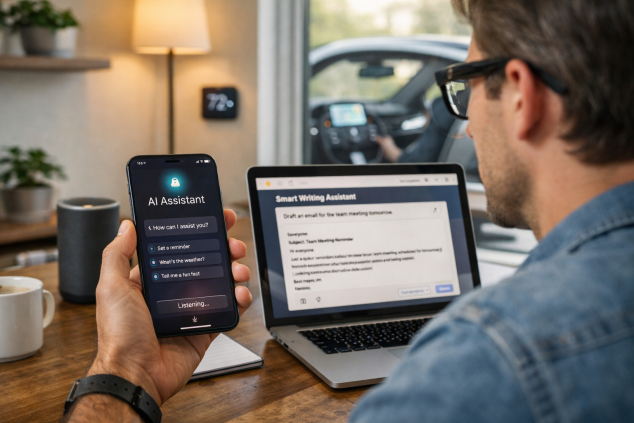
AI is already woven into the way we work, plan, create, and make decisions each day. This is a practical look at where it quietly fits into real routines and how to start using it with purpose.
AI stopped feeling futuristic for me the moment I realized how often I was already relying on it without thinking twice. It shows up quietly, tucked into routines that feel ordinary. Writing an email, planning a route, sorting photos, searching for an answer while cooking dinner. AI in daily life is less about grand breakthroughs and more about friction slowly disappearing. Once you notice it, you start to see how deeply it has settled into the background of how things get done.
Most people meet AI through assistants on their phones or computers, and that is still where its value feels the most immediate. I use AI tools daily to draft notes, clean up rough ideas, summarize long documents, and sanity check decisions before they turn into time sinks. This is where AI productivity becomes tangible. It does not replace thinking. It clears the clutter around thinking. Tasks that once required full focus now take minutes, which adds up fast over a week.
Outside of work, AI keeps showing up in ways that feel almost invisible. Navigation apps adjust in real time based on traffic patterns learned from millions of drivers. Streaming services understand mood shifts better than expected. Smart home systems learn routines without constant setup. Even wearables quietly use AI to flag sleep patterns or health changes that would be easy to miss otherwise. These systems are already woven into everyday choices, which is why AI daily life feels natural rather than forced.
Creative work has been one of the biggest surprises. I regularly lean on AI tools to explore angles I would not have reached alone, whether that means shaping a rough outline, testing headline ideas, or organizing research into something usable. The value is speed and clarity. AI does not replace creative judgment. It shortens the distance between idea and execution, which matters when momentum is everything.
What makes this moment different is accessibility. You do not need technical knowledge to start using AI in practical ways. Many of the most useful tools are built directly into software people already use at work, in cars, or at home. Email platforms, photo libraries, note apps, browsers, and search tools now include AI features by default. That means adopting AI productivity habits often comes down to paying attention to settings that already exist.
There is also a long-term reason this matters. AI is not being bolted onto products as a novelty. It is becoming infrastructure. Publications like MIT Technology Review regularly point out that the most lasting technology shifts are the ones that quietly improve systems people already depend on. That is exactly where AI tools are heading. They get better as they fade into the background, learning patterns and reducing effort without demanding attention.
What I find most compelling is that using AI well is less about chasing features and more about noticing small wins. Saving ten minutes here, reducing decision fatigue there, catching errors before they compound. Over time, those gains stack. AI in daily life works best when it feels like a helpful layer, not a centerpiece. That is why it is easy to see this becoming an ongoing utility, one that continues to shape how we work, create, and manage everyday tasks for years to come.
Pros:
- Saves time on everyday tasks by reducing manual effort and repetitive work
- Improves focus by handling background details so attention stays on decisions that matter
- Fits naturally into tools people already use at work, in cars, and at home
- Helps organize ideas, information, and schedules without adding complexity
- Continues to improve quietly as systems learn patterns over time
Cons:
- Can encourage overreliance if used without critical thinking
- Results vary depending on the quality of input and context provided
- Raises ongoing concerns around data privacy and transparency
- Still requires human judgment to catch nuance and errors
Bottom Line:
AI works best as a steady support layer rather than a centerpiece. When used with intention, it removes friction from daily life, sharpens productivity, and earns its place as a long-term utility rather than a passing trend.
Tags:
AI tools, AI daily life, AI productivity, Everyday AI uses, AI assistants, Practical AI applications, How to use AI, AI in Everday Life