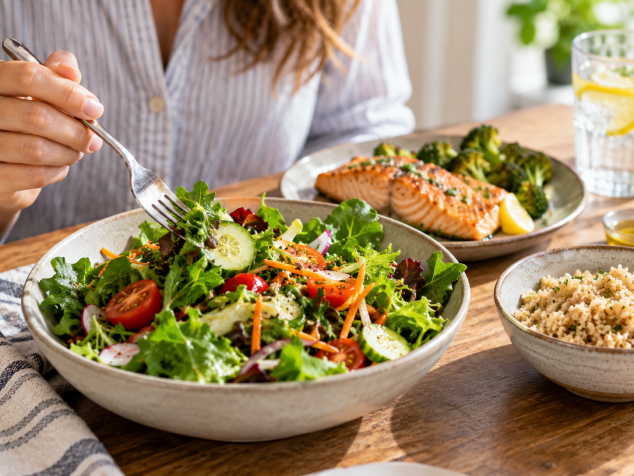
Food sequencing puts vegetables and protein before carbs. Learn what research says about blood sugar, fullness, appetite, and whether meal order matters.
Can simply changing the order in which you eat the exact same foods make a meaningful difference? That was the part of food sequencing that initially sounded almost too tidy to me. Food sequencing, also called meal sequencing, means eating foods in a deliberate order, usually starting with vegetables or another fibre-rich food, moving to protein and fat, and saving carbohydrate-rich foods for later in the meal. Think salad or roasted broccoli first, salmon or tofu next, then rice or potatoes. The idea has received more mainstream attention lately, including a Harvard Health feature published in April 2026, largely because researchers have found that eating vegetables or protein before carbohydrates can change the blood-glucose response to a meal.
The reasoning behind vegetables before carbs makes more sense once you picture digestion as a process rather than everything on the plate arriving in your bloodstream at once. Fibre can slow the digestion and absorption of carbohydrate, while protein and fat eaten earlier may delay gastric emptying and influence hormones involved in digestion and glucose regulation. When bread, pasta, rice, potatoes, or another concentrated carbohydrate arrives later, glucose may enter the bloodstream more gradually. That can mean a smaller early rise in blood sugar after meals. Researchers have also observed differences in insulin and gut hormones depending on food order, although the size of the response varies with the meal and the person eating it.
So, does food sequencing work in otherwise healthy adults? There is enough evidence for me to take the idea seriously, with a sizeable asterisk beside it. A 2026 systematic review found six eligible studies involving only 107 healthy adults. Most reported lower post-meal glucose responses when vegetables, fruit, or protein-rich foods came before carbohydrates compared with eating carbohydrates first or consuming the meal in another order. Small randomized crossover studies have found similar effects. That sounds encouraging, though 107 people is a very small foundation for sweeping dietary advice, and most studies look at what happens over a few hours rather than whether meal order changes health over months or years. A newer meta-analysis of vegetable-first randomized trials also found improvements in early post-meal glucose measurements, while rating the certainty of the evidence as very low because of limitations in the underlying studies.
The case may be more relevant for people already dealing with impaired glucose regulation. Studies involving prediabetes and type 2 diabetes have repeatedly reported smaller post-meal glucose excursions when carbohydrates are eaten later in the meal. A 2026 systematic review of studies in people with diabetes found that most supported the carbohydrate-last pattern, although the authors rated the overall certainty as low because study designs differed and participant numbers remained modest. That distinction matters. Normal glucose rises after eating are part of ordinary physiology, so a healthy person does not need to treat every increase as a problem. Meal composition, carbohydrate quality, serving size, physical activity, and metabolic health can all have a larger influence on blood sugar after meals than rearranging the forkfuls on your plate.
Fullness is where food sequencing gets especially interesting to me, although the evidence becomes fuzzier. Starting with vegetables and protein means I am eating foods that tend to be filling before reaching the rice, bread, or pasta, which could make it easier to notice when I have had enough. Some small studies have reported greater fullness with a vegetables-and-protein-first sequence, yet systematic reviews have found very limited and inconsistent evidence for hunger and satiety outcomes. I would therefore hesitate to claim that food sequencing automatically leads to portion control. I still like the psychology of it. I can have pasta, sourdough, potatoes, or dessert without turning them into foods that need to be avoided. The experiment is simply to see whether eating them later changes how the meal feels.
I also would not make the eating order rigid. A dinner with separate components makes vegetables first and carbs last easy. Mixed dishes are another story. Nobody needs to dismantle a taco, excavate the noodles from a casserole, or eat a sandwich layer by layer in the name of metabolic perfection. With pasta, soup, stir-fry, or another mixed meal, having some vegetables first is a reasonable approximation if it happens naturally. Harvard Health makes a similar practical point, suggesting a side salad or vegetables before a combination dish while emphasizing that every meal does not need to follow the sequence. That flexibility is important because a healthy habit quickly loses its appeal when dinner starts feeling like an instruction manual.
For me, vegetables first and carbs last is a healthy habit worth trying because it asks for very little and has a plausible short-term effect on post-meal glucose. I would pay more attention to it if I were eating a meal built around refined carbohydrates, and much less if I were sharing pizza with friends or digging into a bowl where everything belongs together. The research gives food sequencing enough credibility to be interesting, while leaving plenty still unanswered about appetite, long-term health outcomes, and how meaningful the effect is for metabolically healthy people. I have ended up treating meal order as a gentle preference rather than a rule: when it is easy to start with the vegetables and save the carbs for later, I probably will.
Pros:
- May reduce post-meal blood sugar spikes when vegetables, protein, and fats are eaten before carbohydrates.
- Does not require cutting out bread, pasta, rice, potatoes, or dessert.
- Easy to try with meals that have separate components.
- May help some people feel fuller earlier in the meal.
- Could be especially useful for people concerned about post-meal glucose control.
- Costs nothing and does not require special foods or supplements.
Cons:
- Research is still limited, with many studies involving small groups.
- Long-term health benefits have not been clearly established.
- The effect may be modest for metabolically healthy adults.
- Meal composition, portions, activity, and carbohydrate quality still matter.
- Mixed dishes such as sandwiches, casseroles, tacos, and pasta make strict sequencing impractical.
- Following the order too rigidly could turn a simple habit into an unnecessary food rule.
Bottom Line:
Food sequencing is one of those habits I find appealing because it is simple and does not ask me to give up foods I enjoy. Starting with vegetables, moving to protein or fat, and eating carbs later may help soften the rise in blood sugar after a meal, although the evidence is stronger for short-term glucose effects than for lasting health benefits. I would treat vegetables first and carbs last as a flexible preference when it fits the meal, rather than something that needs to be followed perfectly.
Tags:
food sequencing, meal sequencing, vegetables before carbs, carbs last, food order and blood sugar, eating vegetables before carbohydrates, food sequencing blood sugar, what is food sequencing, does food sequencing work,