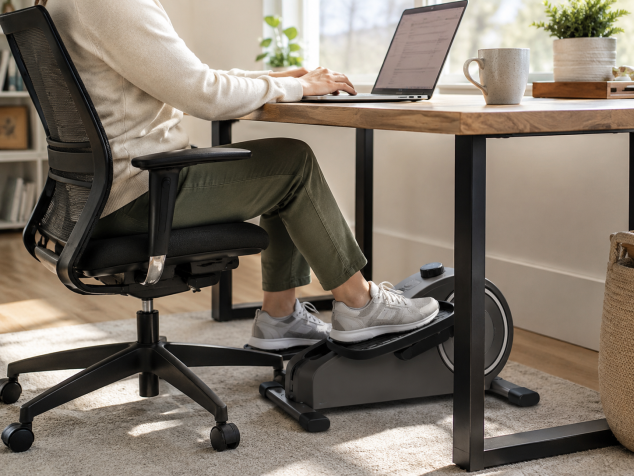
Under-desk ellipticals offer a simple way to add gentle movement during work, television time, or other long periods of sitting.
An under-desk elliptical sounded slightly gimmicky to me until I considered how many hours a normal workday can disappear into a chair. Even with good intentions, back-to-back tasks make it easy to postpone a walk or skip a planned workout. This compact piece of seated exercise equipment offers a practical alternative: gentle pedaling during time that would otherwise involve almost no movement. It earned a place among my favourite home office fitness equipment because it asks for very little preparation. I can slide it into position, lower the resistance and start moving without changing clothes or stepping away from routine work.
The product category includes several designs that are often grouped together despite feeling different in use. An under-desk elliptical usually moves the feet through a shallow gliding path, while an under-desk bike uses a circular cycling motion. A mini pedal exerciser is a broader term that commonly describes compact crank-style machines that can be used from a chair. Whichever design you choose, the important details are footprint, desk clearance, resistance range and stability. A machine that is too tall may cause your knees to hit the desk, while a lightweight model can creep across a smooth floor. Quiet operation also matters more than expected, especially when the equipment will be used near coworkers, family members or an active microphone.
This type of exercise equipment for people who sit all day makes the most sense for remote workers, office employees and beginners who find formal workouts difficult to fit into their schedules. It may also appeal to older adults or anyone cautiously returning to regular activity, provided the movement feels comfortable for them. Verywell Fit’s 2026 equipment testing described under-desk bikes as a way to introduce low-impact movement into periods that would otherwise remain sedentary, which captures the category’s real value without overselling it. The machine does not need to deliver an intense workout to be useful. Its purpose is to make small periods of activity more accessible while someone answers emails, watches television or handles simple administrative work.
A sensible under-desk workout for beginners starts with approximately 10 to 15 minutes at low resistance. The pace should feel smooth and controlled rather than rushed, with both feet sitting securely on the pedals. Chair height matters because sitting too low can create an awkward knee angle, while sitting too far from the machine may cause the hips to rock forward with every rotation. I prefer to position the exerciser close enough that I can keep my back against the chair and my shoulders relaxed. Resistance should initially be light enough to maintain steady motion without straining or changing posture. After several comfortable sessions, the duration or resistance can be increased gradually instead of raising both at once.
A balanced beginner week can use the under-desk elliptical as one part of a wider routine. On Monday and Thursday, 20 to 30 minutes of easy pedaling can fit into routine desk work, particularly during reading, inbox cleanup or other tasks that do not require intense concentration. Tuesday and Friday can include a short full-body strength session with chair squats, wall push-ups, rows or light dumbbell exercises. Wednesday works well for two or three brief seated movement sessions spread across the day, which can be easier to manage than one longer workout. The weekend can include walking, mobility work, recreational activity or rest based on energy and schedule. Alternating seated cardio with strength work and recovery creates a more complete starting routine while keeping the mini pedal exerciser in its proper role.
Using desk exercise equipment effectively requires some trial and error. Lower resistance works best for typing because heavier pedaling can make the upper body shift slightly, which becomes distracting during detailed work. I raise the resistance a little while watching television, when I can pay more attention to maintaining a deliberate pace. Fast pedaling rarely works well during video calls because the movement may become visible and breathing can sound less natural. A non-slip mat helps keep the machine stable, particularly on hardwood or tile. It is also worth starting with shorter sessions, since the hips or knees can feel overworked when someone goes from very little seated movement to long daily sessions immediately.
My final opinion is that an under-desk elliptical is worth considering for people who want movement to fit more naturally into an already crowded day. It will not replace walking, strength training or regular cardiovascular exercise, and it should not be marketed as though it can. Its biggest advantage is repeatability. A low-impact desk workout completed several times a week is easier to sustain when the equipment is already sitting near the chair. For remote workers, beginners and anyone who spends evenings on the couch, this compact fitness trend can turn a portion of inactive time into gentle, intentional movement without making the entire day revolve around exercise.
Pros:
- Adds gentle movement during desk work or television time
- Low-impact and approachable for beginners
- Compact enough for many home offices and living rooms
- Adjustable resistance supports different effort levels
- Makes otherwise inactive time more useful
- Easier to repeat regularly than a formal workout
Cons:
- Cannot replace walking, strength training, or full cardiovascular workouts
- May slide on smooth floors without a non-slip mat
- Taller models can cause knee-clearance problems under a desk
- Pedaling may distract from typing, calls, or detailed work
- Poor chair height or foot placement can make the movement uncomfortable
Bottom Line:
Under-desk ellipticals are a practical choice for remote workers, beginners, and anyone who spends long periods sitting. Their greatest value comes from making light movement easier to fit into everyday life, especially when used alongside walking, strength work, and other regular activity.
Tags:
under-desk elliptical, mini pedal exerciser, seated exercise equipment, low-impact desk workout, exercise equipment for people who sit all day, home office fitness equipment, under-desk workout for beginners, mini pedal machine, seated workout equipment