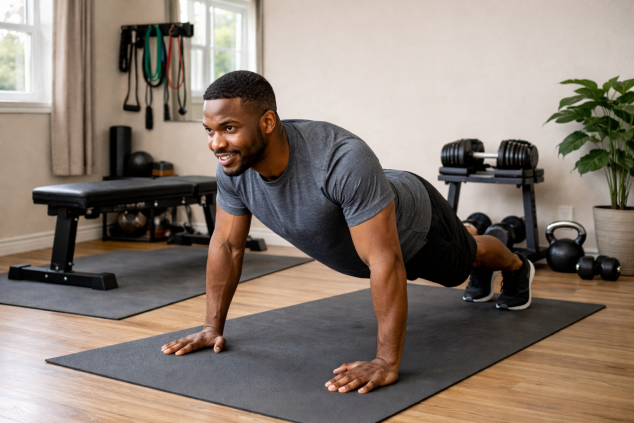
You do not need a full gym or a complicated plan to build real momentum at home. A few smart choices and steady habits can support a workout routine that grows naturally as you do.
Simple home workouts work for beginners because they remove the friction that usually stops people from starting. There is no commute, no pressure to perform, and no confusion about where to begin. When I first started a fitness routine at home, the appeal was control. I could move at my own pace, repeat workouts without judgment, and learn what my body actually responded to. That quiet consistency is what makes a beginner workout routine at home stick. It feels manageable enough to return to, which matters more than any perfect plan.
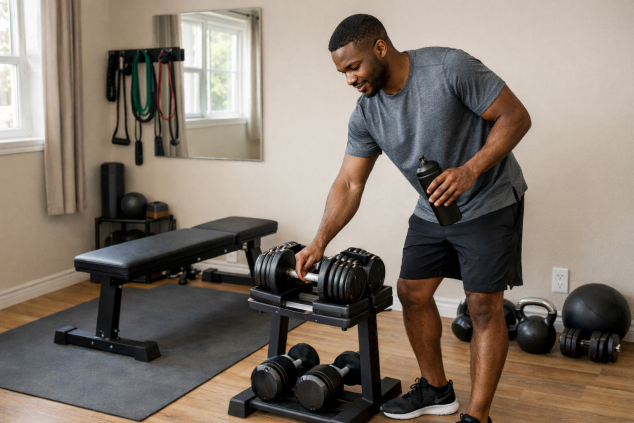
Early on, the equipment that mattered most was basic and flexible. Adjustable dumbbells earned their place quickly because they allowed small increases in weight without replacing anything. Resistance bands filled in the gaps, especially on days when joints felt tired or space felt limited. A simple mat made the floor work comfortable and turned stretching into something I actually did. For cardio, I kept it optional. Sometimes that meant brisk walks outside, sometimes a compact bike tucked into a corner. Building a home gym on a budget worked because every item had more than one use.
The workouts themselves stayed intentionally simple. I focused on full-body sessions three times per week, built around movements that used more than one muscle at a time. Squats, presses, rows, and hinges showed up often, mixed with core work that supported better posture. Rest days were part of the plan, not an afterthought. Starting a fitness routine at home felt sustainable because recovery had the same importance as effort.
As weeks turned into months, the setup grew without feeling cluttered. I added weight plates instead of buying new dumbbells. Bands with different tension levels made familiar exercises feel new again. Progress came from adding a little resistance, slowing down reps, or extending a session by a few minutes. A simple home gym setup worked because it evolved quietly alongside the habit itself.
Avoiding burnout came down to paying attention. On low-energy days, I shortened the workout instead of skipping it. On stronger days, I leaned into the challenge without forcing it. That balance kept the routine grounded. The goal was never to chase exhaustion. It was to build trust that showing up most days would be enough.
Over time, the routine stopped feeling like something I had to plan. It became part of the week in the same way meals and sleep already were. The equipment stayed familiar, the workouts stayed flexible, and progress showed up in small, steady ways. Fitness grew through repetition and patience, proving that consistency carries more weight than complexity ever could.
Pros:
- Easy to start with minimal space and cost, which lowers the barrier to building a consistent habit.
- Equipment like adjustable dumbbells and bands supports progress over time without constant upgrades.
- Flexible scheduling makes it easier to maintain a beginner workout routine at home around real life.
- Familiar surroundings reduce pressure and help workouts feel repeatable instead of intimidating.
Cons:
- Limited equipment can feel restrictive once strength levels increase, especially for advanced lifting goals.
- Motivation depends more on personal discipline without the structure of a class or gym setting.
- Progress may feel slower if cardio options or heavier resistance are not gradually added.
Bottom Line:
A simple home gym setup is one of the most sustainable ways to start a fitness routine at home and actually stick with it. When the focus stays on consistency and gradual progression, it becomes a long-term solution rather than a temporary phase.