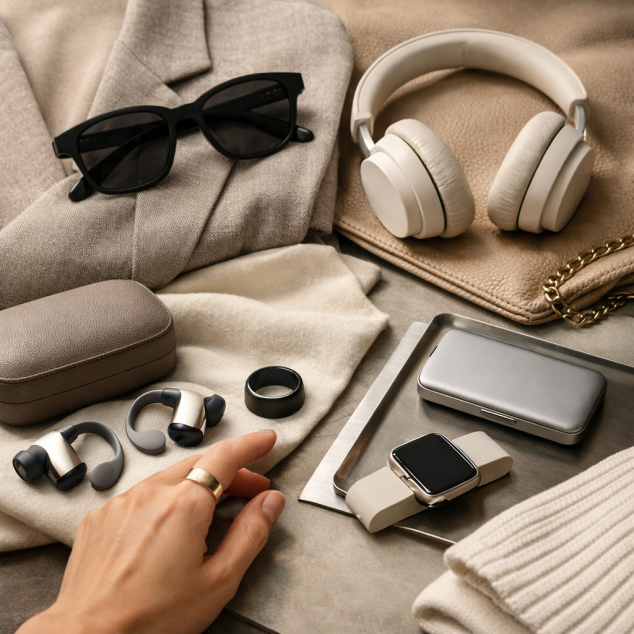
The best gadgets no longer live quietly in your pocket or on your desk. From smart glasses to premium headphones and sleek smart rings, today’s most desirable tech is being chosen as much for personal style and wearability as for performance.
A lot of consumer tech used to live in one lane: useful, powerful, occasionally ugly. You bought it because it solved a problem, then did your best to ignore how it looked clipped to your pocket, hanging around your neck, or sitting on your face. That’s changed fast. Now the most interesting electronics are the ones people want to wear, display, and work into their everyday look. The shift feels obvious once you notice it. Tech is no longer just part of your setup. It’s part of your silhouette.
You can see it most clearly with smart glasses. A few years ago, wearable technology in that category still had a prototype energy to it. Too bulky, too self-conscious, too much “future” and not enough “person.” The newer wave feels different because brands finally understand that glasses already carry social meaning. People care about frame shape, lens tint, weight on the bridge of the nose, and whether they actually look good walking into a coffee shop or dinner wearing them. If smart glasses are going to live on someone’s face for hours, they need to feel like eyewear first and hardware second. That design priority says a lot about where fashion tech is heading.
Smart rings might be the cleanest example of this whole movement. They make sense because they fit into a category people already understand: jewelry. A ring doesn’t need to announce itself to earn a place in your daily routine. It just has to feel good on your hand, look refined up close, and avoid that plasticky “tech product” finish that kills the mood instantly. The appeal of smart rings has as much to do with discretion and polish as it does with health tracking or sleep data. A well-designed ring feels considered in the same way a good watch or chain does. That matters more than a lot of tech companies used to think.
Premium headphones have followed a similar path, especially over-ear models that now function almost like outerwear for your head. People notice the texture of the earcups, the shape of the band, the metal accents, the case, the colorway. They think about whether they look sharp on a commute, in an airport lounge, or at a shared workspace. That wasn’t always true. Today, premium headphones are one of the clearest examples of stylish tech gadgets becoming visual shorthand for taste. Some pairs signal clean minimalism. Others lean fashion-house luxury. Either way, they’re being worn with intention.
Wearable audio is pushing this even further. Open-ear audio and low-profile listening gear have a very specific kind of appeal because they feel more integrated into real life. They don’t isolate you from the world in the same way traditional earbuds or giant cans can. They sit lighter, look subtler, and often feel more aligned with how people actually move through the day. There’s something very current about tech that respects your outfit, your face shape, your hair, your commute, your gym session, and your need to still hear the world around you. That’s lifestyle tech thinking, and it’s one of the reasons these products are catching on.
The rise of design-forward gadgets also says something bigger about how people shop now. A lot of everyday tech accessories are being chosen the same way someone might choose sneakers, sunglasses, or a bag. Finish matters. Proportion matters. Texture matters. You see it in slim battery packs with soft-touch materials, charging docks that look like decor, phone cases that feel curated instead of purely protective, and compact EDC gear that seems designed to disappear into a clean outfit. These are smart accessories, sure, though they’re also style decisions. People want gear that belongs in the same visual world as the rest of their life.
Socially, this shift makes perfect sense. We spend too much time in public with our devices for them to stay purely utilitarian. People wear their tech on walks, at brunch, in meetings, on planes, at the gym, on dates, and in mirror selfies whether they admit it or not. Once a gadget becomes visible enough, it starts communicating something. You can tell when someone chose a device because it works, and you can also tell when they chose it because it fits the version of themselves they want to project. That’s where consumer tech trends start crossing into identity, and once that happens, fashion is already in the room.
I think this is going to stick because it solves a real tension in modern life. People want powerful tools, though they also want a calmer, more intentional physical environment. They want wearable gadgets for men and women that feel polished, subtle, and worth keeping around all day. The brands that win from here will probably be the ones that understand wearability as deeply as performance. They’ll build products that feel good in the hand, look good in motion, and hold up as part of someone’s daily visual language. That’s when tech stops feeling like equipment and starts feeling personal.
Pros:
- Tech feels more personal and expressive, giving people a way to reflect their style through everyday gadgets like smart rings, premium headphones, and smart glasses.
- Design quality has improved across the board, with better materials, cleaner finishes, and more thoughtful form factors.
- Wearable technology is becoming more comfortable and practical for all-day use, which makes it easier to integrate into real routines.
- Lifestyle tech is easier to pair with clothing and environments, so devices don’t clash with how someone wants to look or present themselves.
- Brands are paying closer attention to aesthetics, which raises the overall standard for consumer tech.
Cons:
- Style-driven tech can come with higher price tags, especially when premium materials and branding are involved.
- Some products prioritize appearance over function, leading to compromises in performance or durability.
- Trendy designs can age quickly, which makes certain gadgets feel outdated faster than traditional tech.
- There’s a risk of overconsumption as people start treating tech more like seasonal accessories.
- Not every design-forward gadget delivers meaningful everyday value beyond how it looks.
Bottom Line:
Tech becoming more like fashion is a natural evolution, especially as devices become more visible in daily life. The best products strike a balance where design and function support each other, creating gear that people actually want to wear and keep using long term.
Tags:
fashion tech, wearable technology, smart accessories, stylish tech gadgets, tech accessories, smart glasses, smart rings, premium headphones, wearable audio, everyday tech accessories, lifestyle tech, consumer tech trends, wearable gadgets